Monday, 4 February 2013

ON THE WAY TO CASTILLO DE AZAGALA

CASTILLO DE LA LUNA -ALBUQUERQUE
A perfectly gorgeous spring day meant it was time for a jaunt into another part of Extremadura by way of Albuqerque. The fabulous Castillo de Luna dominates the town, unfortunately closed for renovation for the next few months but because of a diversion we found the beautiful XIIIth century
church of Santa Maria del Mercado, a gem, beautifully restored except for the garish new stained
glass windows.
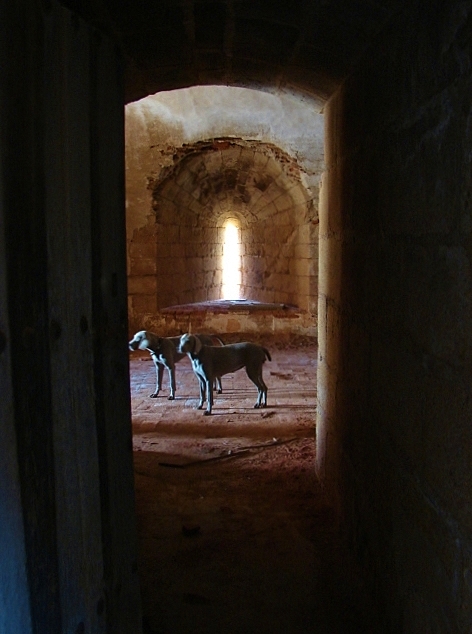
We left Albuquerque in the direction of the Embalse de Peña de Aguilla, after about 8kms there is a sign for Castillo de Azagala on the left, it's a fairly good earth camino, pass through 3 gates and then park the car and walk for 30 minutes up to the castle. A lovely walk through a typical Extremadura landscape of holm oaks with the lake sparkling in the foreground and the castle towering over the scene on a high crag. Gormenghastly! And was to proove even more so as we reached the ancient portal and walked into a place forgotten by time.


It was a most extraordinary feeling of stepping into an ancient space, the physical condition was ruinous but the shape and format remained incredibly solid, one felt immediately encapsulated, protected and enveloped by deep tranquility. The long walk up 52 steep steps of the torre de menáge was not worrying, the stone steps had survived  seven centuries of tramping. We emerged at the top to see the whole castle below us and the blue waters of the lake rippling below.
 
 
There were stables, cellars, tunnels, a chapel with broken alter and over-turned holy water stoop, arcades, a bell tower, turrets, a long drop lavatory with wooden seats, huge open chimneys.
 A 19th century wing with an abandoned billiard table slate top intact, a glassed in walkway, rooms of broken beds, tables and chairs, fluttering velvet curtains, a whole world of staid domesticity broken, torn and decaying. Who were the last people to live in this remote castle? When did they leave? Why did they leave? We thought maybe after a long period as a defensive castle it had been abandoned for centuries and maybe the owning family had moved back for periods in the 18th -19th century, perhaps more abandonment and a partial use until about 50 years ago judging by the remains of the furniture and the kitchen "appliances".  Here is a link to the history of Azagala in Spanish


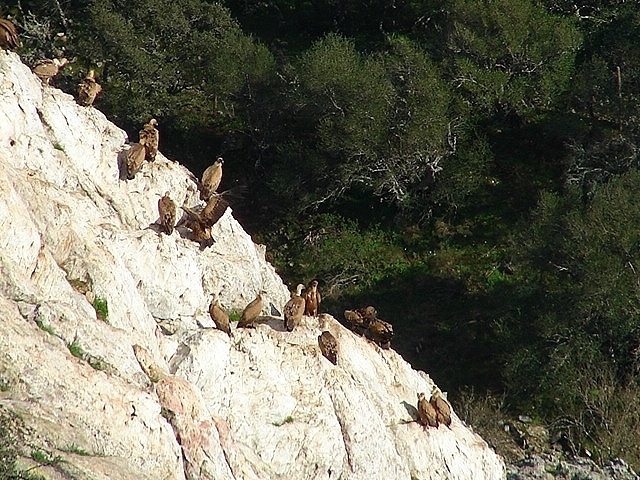
One of the most sensational elements of Azagala is the colony of Griffon Vultures nesting on the crags by the stream that feeds the lake. It's a wild and remote place but there are views directly down onto the crags from the walls of the castle so we were able to observe the vultures as they sunned themselves on the rocks and swooped about the castle walls. A magical spectacle.                      


Saturday, 12 January 2013

HOMAGE TO EXTREMADURA IN THE GUARDIAN- December 2012

Yellow arrows guide the Northerner's pilgrim Alan Sykes through the little-publicised wonders of a lovely region. And his pedometer has clocked up a million footsteps
A footprint in soil
Alan has left more than a million of these in Spain so far.
Photograph: Christopher Thomond for the Guardian
 
After around a fortnight and 350km, the camino finally led me out of Extremadura, over a high pass on an almost perfectly paved Roman road, up into the sierra and into the region of Castilla-León, where I will be for the next 350km.
If this stretch is anything like as enjoyable as the last ones, I am in for yet more treats, although the worsening weather may have other ideas. Extremadura has been an almost constant series of surprising delights. I had barely heard of most of them before my first visit. Even lordly Cáceres I mostly knew about because, for several years, the Marqués de Cáceres was a drinkable cheap red wine sold in some British supermarkets.
olives Zafra extremadura Olives being harvested north of Zafra, in Extremadura

The towns, the villages, the countryside, the wildlife, the food, the wine, the architecture, the Roman remains, the Visigothic traces, the mediaeval survivals - all have been an almost uninterrupted pleasure.
Not forgetting the climate: one morning it drizzled on me for a couple of hours – not even hard enough to make it worth getting my coat out of the rucksack – and otherwise it has been almost uninterrupted sunshine since leaving Andalucia.
palace wine extremadura A palace of wine and olive oil in Almendralejo - what more can one want?

The clear skies also helped star gazing, mostly with little light pollution. So for several nights running it was possible to watch the waxing moon playing catch-up with Jupiter - and the two very nearly bumped into each other the night I was in Cáceres. Leaving before dawn most mornings meant that I usually had Venus as a companion until 8.30 or so. 
Merida roman bridge The longest bridge in the Roman Empire, at Mérida

From the glory that was Cáceres, the grandeur that was Mérida and the gaiety that was Zafra, the major towns all had very different attractions. But even the 'one horse towns' usually had something special going for them. In Fuente de Cantos, the 'one horse' was Zurbaran, while other attractions included the ham and cheese museums of Monesterio and Casar de Cáceres, a little Visigothic chapel outside Alcuescar, the Almohad dynasty ramparts at Galisteo, the oaks being harvested for cork, coming upon a majestic wild boar less than 50 yards off, having a Roman bath in Baños de Montemayor, the triumphal arch at Cáparra and I've forgotten how many Roman bridges of various sizes
cork oak Extremadura A holm oak after its once every 7-9 years cork harvest

The Via de la Plata, the Roman road that runs right through Extremadura makes navigation relatively simple, as it almost always coincides with the resurrected camino de Santiago. The junta of Extremadura has put in some easy to read marker stones all the way along the road. In addition, the people responsible for the camino to Santiago have painted yellow arrows along "their" way. Between the two sets of way-markers, it's difficult to get lost, and it's very easy to travel very economically. Staying in the albergues that have been established for the pilgrim route is almost astonishingly good value - although for some you do need a credencial, or pilgrim passport. It's not grande luxe – mostly basic bunk beds and hot showers - but normally after a long day walking and a pleasant evening eating a menú del día (sometimes a special pilgrim menu), sleep comes easily and usually soundly. As it's so out of season, only once have I had to share a dormitory with other travellers. 
The albergues are run by a mixture of organisations: some subsidised by the Junta of Extremadura, some run by religious confraternities, some by the local town hall, and an increasing number of private ones have sprung up as the traffic on this route increases. In the nine nights between Mérida and Salamanca, I spent €74 on accommodation. This ranged from the completely free municipal albergue in Casar de Cáceres, to €12 for a night in a private albergue. The one in Alcuescar is in the Casa de la Misericordia, where the religious order of Los Hermanos Esclavos runs a residential hospital. At Fuenterroble de Salvatierra, up in the sierra south of Salamanca, the albergue is in the same complex as the parish hall, set up by the long serving parish priest Don Blas Rodriguez, who is mainly responsible for opening up the camino on this isolated stretch.
Extremadura camino de Santiago

Alan Sykes is the Guardian Northerner's arts expert and much else, including temporary cookery correspondent of The Hotspur parish magazine. He is trekking 1000km to Santiago de Compostela to expiate unknown sins. You can read his earlier reports from the camino here.

LinkWithin

Related Posts Plugin for WordPress, Blogger...