Wednesday, 29 September 2010

Books


This will be an on going report on our somewhat eclectic reading lists, often controlled by what we can get hold of in the wilds of Extremadura occasionally suplemented by swaps or donations from our lovely clients, special treats ordered from Amazon and travel guides and maps brought back from latest travels. A substantial amount of re-reading or dipping into dusty, musty books from parents or even grandparents, also passionate biliophiles in their time.
A quirky American site for the "cruel and unusual" is book whores which is encorporated into http://www.blastmilk.com/bookwhores/shop/index.html where you can find some interesting book lists and images! For reading or copying popular, classic and esoteric books on line the Project Gutenberg is one of my favourites http://www.gutenberg.org/
 
Desperate for books at the moment, our main source of reading material, the charity shops of the Algarve, had dried up as the daughter moved away from there for a while but good news, she's moving back so my visits will only be ostensibly to see her but really to raid the book shops.
What we have been re-reading is more accurate lately. Lots of Moroccan stuff as we are plotting and planning our Moroccan retreat south of the Atlas mountains. Paul Bowles is always very good in a very detatched manner, almost reportage and mainly about Northern and Middle Morocco rather than the deep South that is our passion.

Wednesday, 15 September 2010

EXCURSION TO PLASENCIA AND LA VERA

EXCURSION TO PLASENCIA AND LA VERA – 1 hour 15 minutes drive from Finca al-manzil

A gorgeous day in the middle of September, Thursday…..market day in Plasencia.

The outskirts of Plasencia are not pre-possessing, a town to whizz through on the way to the delights of Salamanca. However, there are many interesting corners in the old part of town including TWO Cathedrals and the market square. I am always delighted by any sort of market, all the hustle and bustle, the outrageously LOUD cries of the stall holders hoping to draw ones attention to their pile of produce which looks identical to all the others. September is the peak time of the red pepper harvest for which the La Vera region is famous, it even has a quality controlled standard for the very best pimenton in the whole of Spain. Pimenton is the lusciously coloured powder made from smoked and ground red peppers, first produced by the monks of Yuste from the first red peppers grown in Europe, cultivated from the seeds brought back by Columbus from the West Indies in the 15th century. Besides huge mounds of the long twisty red peppers there were beautifully ripe fruit and vegetables grown in the rich, well watered soil of the La Vera. I bought a kilo of garlic with really fat cloves, well dried and tinged with lilac, a large wedge of local cheese and some scrumptious bumpy bread with seeds and nuts, this baker also sold slices from a huge tuna, red pepper and tomato pie, I bought some of that too for our picnic which seemed to be getting more and more gargantuan as I went from stall to stall. There was also a stall selling some really archaic looking agricultural implements all in shiny new steel, some lovely wood and steel pocket knifes.

It was getting hot by now so we had a cool drink in one of the cafés around the square and then, somewhat loaded down, took the long way back to the car past the cathedrals.

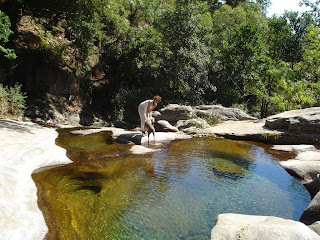
From Plasencia we headed out into the pretty countryside in the direction of Garganta da Olla which is a delightful small gorge with natural rock pools. In September there were still a few people swimming and lying around on the rocks but just a few and we found a good spot for our picnic besides a deep pool with smooth warm rocks, Roxy was in heaven slithering in and out of the water, we were less adventurous and merely dipped out toes in as we ate. A really special place with huge frondy water plants and shady trees amongst the rocks. Easy walking by the stream with many little detours.
Next stop the Monastery at Yuste. I love this place buried in deep quiet woods, surrounded by a high wall and a most romantic aspect with its lofty open porch at the front overlooking the fish pond and gardens.
It was here that the Emperor Charles V came to retire from the world, to rest his gouty foot from a specially designed chair, still to be seen today, or to lie in his bed directly next to the high alter participating in the many masses said for his eternal soul. For such a mighty emperor this was a simple hermitage where he wished to end his days but it seems a magical place to me, I do wish I could visit the cool cloisters and secret rooms but these are still in use by the monks and one only has a little glimpse.

                                                                  The gout chair

We continued on to the little village of Cuacos de Yuste where the future Philip II stayed whilst visiting his father. Some charming corners and interesting local architecture all festooned with hanging bunches of drying peppers. A few bars on the main square, of course we ordered Yuste beer which was originally brewed by the monks, really rich and malty. From here we drove slowly back to the autovia and headed back to Finca al-manzil. An interesting and certainly fruitful day out.

Sunday, 5 September 2010

IT'S FIESTA TIME AGAIN IN MONTANCHEZ


Every year at the beginning of September Montanchez celebrates its most important fiesta, La Virgen del Castillo. The image of the Virgen stays up in the castle church for the whole year except for these nine days when she is brought down into the church of San Mateo in the village. The journeys down the hill and back up to the castle each involve a procession which is joined by most of the population of the village. The initiation of the fiesta is the downward journey, the ornate and beautifully decorated float is  borne aloft by several sturdy men and proceeded by the village band, it makes its way slowly down the steep hill until arriving at the doors of the church.  It's always a moving moment when  the virgen arrives safely at the church, there is a spontaneous outbreak of loud clapping and beaming smiles as everyone troops in for the blessing. 


As well as the processions there is continuous fiesta atmosphere in the Plaza de España with all the cafes and bars arranging their tables and chairs out in the open to enjoy the long warm evenings. There are also various other day time activities including the correo de cinta, a horse riding competition. The riders and horses are all wearing their traditional gear and looking very dashing. A string of rings are stretched over the course and the riders attempt to secure the rings with a short lance, this is not easy at full gallop.
Horses assemble before the correo de cinta


Manfred a.k.a. Don Quixote makes his choice


After another copa in the plaza time to go home through  another plaza, Altozano, which has a pretty fountain, palm trees and in this photo the full moon.


Thursday, 2 September 2010

W. Eugene Smith - Spanish Village 1951- Life Magazine

An ancient method of spinning flax yarn

W. Eugene Smith was an America photo journalist working for Life magazine. He came to to the Extremadura village of Deleitosa in 1951 and spent some time there recording the daily life of the village. These images are extraordinary, they show a life that seemingly had not changed in its gruelling poverty for hundreds of years. The faces of the people are sculpted down to the bone by hard work and little to eat. Such was Franco's rural Spain in Extremadura. The image of the the three Guardia Civil seems to portray the very hard and cruel truth of keeping order, fascist order that is. And how well they succeeded and for how long, no wonder it took Spain such a long time to launch itself into the 20th century as these images testify.


Guardia Civil wearing their ridiculous patent leather hats

Another, seemingly less important, but telling level of fascist dictatorship was fashion dictatorship. My mother told me how she was stopped by the Guardia Civil in Madrid while travelling between
England and Portugal in the late 1950s, She was wearing some lovely black linen capri pants, the latest thing every where else but the sight of her parading around in these was definitely NOT ACCEPTABLE !! She was given a stern lecture and sent off to change into something ........something more FASCIST.
 
 
Grain flying as women winnow the wheat on the eira

Deleitosa is not in Las Hurdes the scene of Buñuel's documentary film 'Las Hurdes-Tierra sin Pan'
 ( The Hurdes- Land without Bread) which was made in 1933, it became an iconic and, being Buñuel, controversial style of documentary, by the way demonstrating the dire poverty of rural Extremadura. Las hurdes still bears this stigma and is not happy about it but these images show that any village in Extremadura was suffering the same fate and nothing had improved in the 20 years separating the two projects. 'Tierra sin Pan' was banned from showing in Spain for several year. I wonder why? Fortunately it was beyond Franco's powers to stop foreign journalistic reports. Bravo Eugene!

LinkWithin

Related Posts Plugin for WordPress, Blogger...