Sunday, 5 September 2010

IT'S FIESTA TIME AGAIN IN MONTANCHEZ


Every year at the beginning of September Montanchez celebrates its most important fiesta, La Virgen del Castillo. The image of the Virgen stays up in the castle church for the whole year except for these nine days when she is brought down into the church of San Mateo in the village. The journeys down the hill and back up to the castle each involve a procession which is joined by most of the population of the village. The initiation of the fiesta is the downward journey, the ornate and beautifully decorated float is  borne aloft by several sturdy men and proceeded by the village band, it makes its way slowly down the steep hill until arriving at the doors of the church.  It's always a moving moment when  the virgen arrives safely at the church, there is a spontaneous outbreak of loud clapping and beaming smiles as everyone troops in for the blessing. 


As well as the processions there is continuous fiesta atmosphere in the Plaza de España with all the cafes and bars arranging their tables and chairs out in the open to enjoy the long warm evenings. There are also various other day time activities including the correo de cinta, a horse riding competition. The riders and horses are all wearing their traditional gear and looking very dashing. A string of rings are stretched over the course and the riders attempt to secure the rings with a short lance, this is not easy at full gallop.
Horses assemble before the correo de cinta


Manfred a.k.a. Don Quixote makes his choice


After another copa in the plaza time to go home through  another plaza, Altozano, which has a pretty fountain, palm trees and in this photo the full moon.


Thursday, 2 September 2010

W. Eugene Smith - Spanish Village 1951- Life Magazine

An ancient method of spinning flax yarn

W. Eugene Smith was an America photo journalist working for Life magazine. He came to to the Extremadura village of Deleitosa in 1951 and spent some time there recording the daily life of the village. These images are extraordinary, they show a life that seemingly had not changed in its gruelling poverty for hundreds of years. The faces of the people are sculpted down to the bone by hard work and little to eat. Such was Franco's rural Spain in Extremadura. The image of the the three Guardia Civil seems to portray the very hard and cruel truth of keeping order, fascist order that is. And how well they succeeded and for how long, no wonder it took Spain such a long time to launch itself into the 20th century as these images testify.


Guardia Civil wearing their ridiculous patent leather hats

Another, seemingly less important, but telling level of fascist dictatorship was fashion dictatorship. My mother told me how she was stopped by the Guardia Civil in Madrid while travelling between
England and Portugal in the late 1950s, She was wearing some lovely black linen capri pants, the latest thing every where else but the sight of her parading around in these was definitely NOT ACCEPTABLE !! She was given a stern lecture and sent off to change into something ........something more FASCIST.
 
 
Grain flying as women winnow the wheat on the eira

Deleitosa is not in Las Hurdes the scene of Buñuel's documentary film 'Las Hurdes-Tierra sin Pan'
 ( The Hurdes- Land without Bread) which was made in 1933, it became an iconic and, being Buñuel, controversial style of documentary, by the way demonstrating the dire poverty of rural Extremadura. Las hurdes still bears this stigma and is not happy about it but these images show that any village in Extremadura was suffering the same fate and nothing had improved in the 20 years separating the two projects. 'Tierra sin Pan' was banned from showing in Spain for several year. I wonder why? Fortunately it was beyond Franco's powers to stop foreign journalistic reports. Bravo Eugene!

Monday, 23 August 2010

Almódovian Lysistrata at Merida Classical Theatre Festival

I think a performance of Lysistrata must have always been a controversial experience starting with the first in 411 BC.........an amazing 2421 years ago.
Aristophanis' play is a comical, verging on farcical account of one woman's unique mission to end the Peloponnesian War. Lysistrata rallies the women of Athens, Sparta and beyond to withhold sexual pleasures from their husbands and lovers as a means of forcing the men to negotiate peace, a strategy that inflames the battle between the sexes. The play is notable for its exposé of sexual relations in a male-dominated society and for its use of both double entendre and explicit obscenities. The dramatic structure represents a shift away from the conventions of ancient comedy to something innovative, a trend typical of Aristophanes' career.
The version at this years theatre festival in Merida had an extra layer of sexual ambiguity as all the leading female roles were played by men with some famous transsexual actors, but not in fact Lysistrata herself played by Paco León a popular comic actor who had never played a woman before.  They all looked gorgeous, very fetching in pseudo Grecian robes with added accessories such as huge platform sandals and cute little handbags.  The mens' roles were played by men who were far less glamorous, not to say a bit weedy or simply decrepit. The old mens' chorus that replaced the traditional old womans' chorus were very funny, portrayed as total misogynists , the star was a dwarf, maybe not very p.c. but dwarfs have to work too and he certainly held his own..........as it were. In one scene the chorus of old men were disrobed and shown in all their very sorry physical shape........I presume that part of their anatomy was some sort of false rubber appliance, I needed my binoculars to check this out. See photo.

Jérôme Savary, the director has created a version that is feminist, bold, transsexual, irreverent, funny and crazy, very reminicent of another great Spanish director,  Pedro Almódovar.
 Paco León played Lysistrata in a spectacular costume with one amazingly real looking exposed breast that somehow reinforced the feminine aspects of the play; amazons, breast cancer  etc. Transsexual aspects were reinforced in one of the final scenes with the campaigning women all waving the rainbow striped flag of the gay/transsexual movement.

Friday, 16 July 2010

Our faithful friends, the Bubo Bubos


I have just received some photos from a client who stayed in the barn last April. He had some good photographic equipment and was able to take this shot of one of the Eagle Owls. They have made at least 2 nests up on the crags above the finca and seem to be in residence most of the year, the place wouldn't be the same without their deep hooting at dusk and dawn. Very difficult to photograph in the wild as the light is dim when they are evident and also they are a long way up on top of the sierra.  I was happy to have this record even though it is not very clear I think it shows how impressive the owls are and the "horns" show up well.
The same client also took some lovely shots of the azure winged magpies and bee eaters. By the way the bee eaters are still around and gave us a spectacular show of acrobatics while we were eating dinner outside last night, really amazing with perpendicular filights up and down.

Thursday, 10 June 2010

The last of the Viper's Bugloss

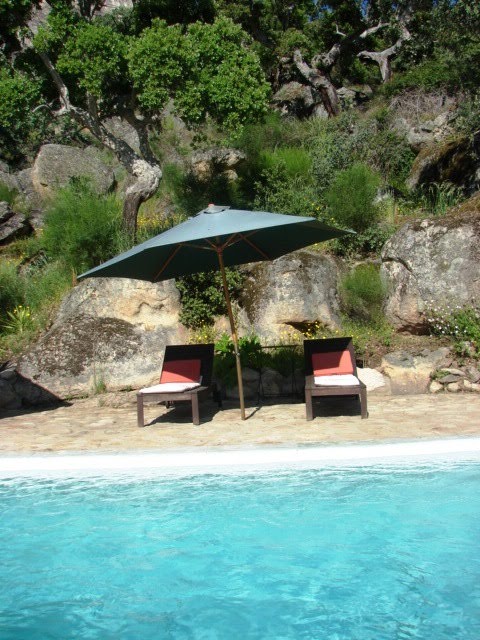
Here it is in all its glory in the barn meadow, first it was blasted by early June sun of up to 30c and now we have had 2 days of heavy rain which has just about finished it off, the camomile is just sweet smelling hay now. The rain is unexpected in June, I had just put up new shade sails at the cortijo, weather changes again tomorrow, back to blue skies and warm sun and my interrupted excercise programme in the pool. Here's my favourite corner of the pool area and I hope to be back there lying in the sun by tomorrow, in the meantime .....where's my umbrella?

Sunday, 2 May 2010

THE LITTLE VILLAGE OF IDANHA-A-VELHA WITH ITS MIGHTY PAST


The peaceful little village of Idanha-a-Velha in Portugal some 40KMS East of Alcantara on the Spanish border and 150kms from Finca al-manzil, has an illustrious past.

It was founded by the Romans and surrounded by an impressively solid stone defensive wall which still exists today. Then it was the Episcopal see under the Visigoths in the VI century before sinking back into obscurity following the Moorish invasion in the VIII century.
It is said to have been the birthplace of a Visigoth king with its own bishops at the cathedral which was restored at the beginning of the 16th century but thankfully still preserves inscribed and sculpted Roman stones.  One of them dating from 16 B.C. links this Roman town of Igeditanos to Extremadura, it reads "Quintus Iallius, a citizen from Emerita Augusta (Mérida) has willingly given a sundial to Igeditanos"

In the Visigoth era, under the name of "Egitânea", the village witnessed a golden age, it became a diocese in 599 and was also gold coin mint. Nowadays all that is left are the ruins of the baptistry, the bishop's palace and the sé (cathedral).  
It seems so odd, all that former Roman and Visigoth grandeur existing in this sleepy little village with maybe 20 inhabitants today.  The ghostly aire is emphasized by a rambling dilapidated 20th century mansion owned by the Marrocos family, it looks as if it has been deserted for years and years, slowly decaying, chunks of stonework fallen and intricate woodwork rotting away. Apparently the family owned thousands of hectares of farmland in the area and evidently had to run away to Brazil at the time of the revolution in 1974 when the workers, in truth merely serfs, took over large estates all over Portugal. A little square in front of the eerie rural palace is dominated by a mulberry tree, obviously the local gossip place where we found out about the history of the mansion whilst indulging in a good old gossip. Aparently the mansion has been acquired by the local council and there are plans for renovation and conversion into a museum of local enthnology, I do hope this will happen.


From Largo de Amoreira (Mulberry tree square) a passage way leads to the Lagar de Vares, an ancient olive oil mill, an interesting part of the industrial archaeology of the area. This recently renovated space shows a first room with two great pressing bars and a boiler; in the next room you can see the olive oil storage tank and the milling place


Around a few more bends in the narrow streets we come to the the Templar Tower , a military building from the 13th century which was erected on the podium of the Roman forum from the 1st century, it seems that on this spot was a Roman temple, possibly devoted to Venus. From the tower there is an exceptional view of the whole village, the spa area becomes obvious and the outline of a vast structure inside the forum to the South.


We walk back through the Roman stones and a little way along the top of the massive 745 metre long Roman wall that surrounds the village, then down to the area outside the walls where a beautiful little chapel sits guarded by the dove of the holy spirit.


PURPLE HAZE - VIPER'S BUGLOSS IN OUR BARN MEADOW


Wednesday, 10 February 2010

HOOP-PETTICOAT DAFFODIL - Narcissus bulbocodium . These sprung up overnight after yet more rain

Wednesday, 3 February 2010

THE FEAST OF SAN BLAS 3RD FEBRUARY


CLICK TO ZOOM
Today is the fiesta of San Blas in Montanchez. Starting from the Ermita de San Blas the procession makes its way to the Plaza de España and then back to the ermita. The girls, of all ages, are dressed in typical folkloric costumes, colourful apliquéd woollen skirts, heavily embroidered shawls, white stockings and black shoes. They carry trays of various cakes and sweets on their heads and kept up a lively step in tune with the band. Many of the crowd wear a red ribbon tied around their necks in honour of San Blas the protector of all throat related afflictions.


San Blas was a doctor and bishop living in Sebaste (Armenia), in the 3rd and 4th centuries. In his striving for perfection he took refuge in a cave near the summit of Mount Argeo. A victim of the generalized persecution of Christians, he acquired his unusual patron-saint status on his way to prison, when he healed a boy who was in agony with a fish bone stuck in his throat. San Blas is often shown with the instruments of his martyrdom, iron combs. The similarity of these instruments of torture to wool combs led to his adoption as the patron saint of wool combers in particular, and the wool trade in general. He may also be depicted with crossed candles. Such crossed candles are used for the blessing of throats on the feast day of Blas which falls on the day after candlemass. The red ribbon may relate to the beheading which ended his torture in 316.

Posted by Picasa

Saturday, 30 January 2010

NEVER ON A SUNDAY?

CLICK ON IMAGE FOR ZOOM

Sunday is not the ideal day for an excursion but somehow old rhythms kick in and it's often on a Sunday that we get that "let's go" feeling. My objection to Sundays is because of something lacking in the hustle and bustle of town and village life....i.e. no shops open! Anywhere else it would mean lots of other people with the "let's go" feeling but here in Extremadura that doesn't really apply.........as you can see in the photos, it's just us, empty roads and hardly a soul around.
We were off to Alcantára and then across the border into Portugal and the newly created Parque Internacional de Tejo/Tajo, a nature reserve covering an area on the border between Spain and Portugal which is divided by the river Tejo in Portuguese and Tajo in Spanish. This was going to be a quick day long excursion but we vow to go again for at least 2 or 3 days to visit all the fantastic medieval villages on the Portuguese side of the border in this area. Our first stop was Alcantára for a coffee at the marvellous Hotel Hospedería Conventual de Alcántara which was the XV century Convento de San Bartolomé, a Franciscan monastery. The order gave up the convent, it fell into a semi-ruinous state then part of it was used as a flour mill in the early XX century. It is a unique entrance, after passing through the traditional austere portal into the convent one is confronted with the towering structure of the flour mill ascending through 3 floors, beautifully restored with shiny brass, intricate mechanisms and creaky wooden staircases. The rest of the convent has been preserved but not restored in its original atmosphere except maybe for the simplicity, quite modern if not exactly edgy. We crossed the eternally impressive bridge of Alcantára, named by the Moors, Kantara-Ass-Saif, meaning "Bridge of the Sword" because a golden Roman sword was found buried in part of the bridge during restoration. The present structure has the original 1st century Roman foundations but has certainly been knocked about a bit since then, not least by the French army in the Peninsula war. Certainly the present impression is of massive stone solidity, much of the ruined Roman masonry was used in the restoration, it's the most marvellous feeling to walk or drive over the huge stone slabs passing by a Roman temple at the entrance, no doubt built for libations to the gods before crossing over the yawning chasm below, nowadays the view up river if rather overwhelmed by the monstrous wall of the new dam.
Soon after the bridge is the border with Portugal, we chose to cross near the village of Salvaterra do Extremo which has a beautiful situation above the river Ergas with a great view across the gorge to the Peñafiel castle seemingly teetering on the edge of a high cliff, flocks of griffon vultures nesting in the towers and the cliff face. Such a sleepy little village surrounded by olive groves and stone walls. No one around except for a few anachronisms, widows in deepest black shuffling towards the very pretty cemetery, maybe for a chat with their dearly departed or just to have a gossip and enjoy the marvellous view down to the river valley.
We continued on our way in a loop back towards the bridge at Alcantára. On the way we clambered down to take a closer look at the water mill by the Puente de Segura. This is also a marvellous Roman bridge from the 1st century, it now marks the border between Spain and Portugal. The mill is down a track on the Portuguese side and is accessed over a small wooden bridge. After all the rain we have had recently the river Ergas was in full flow, dramatically crashing over the weir beyond the mill pond. The mill is a ruin but interesting to see the remains of mill stones and the various mechanisms still surviving under the domed roof : built in this way to withstand the times when it would be completely submerged by swirling water.


Over the bridge and back to Spain, just before Alcantára we made a detour to the village of Estorninos which means Starlings in Spanish. Seemingly deserted, this is the end of the road nowadays but in the centuries after the re-conquest when the Ruta de Santiago saw a constant throng of pilgrims this was the first stop after crossing the bridge at Alcantára, the church is dedicated to San Tiago, it has a curious bell tower separated from the nave. As we were retracing our route we noticed a sign for a megalithic menhir on a rough camino, El menhir del Cabezo, which of course was irresistible, especially as they are so rare in Extremadura, in fact there are none south of the Tajo.
Posted by Picasa
There was no indication of distance but the sun was still shining and Roxy needed a walk so off we went. Just at the beginning of the track was a ruined humilladero which is a small chapel for praying on the route of a pilgrimage; with its domed roof it reminded me of marabouts which are scattered all over Morocco in honour of various sidis or saints. Nearly an hour later we were still walking hopefully in the right direction, the signs were few and far between, a simple white and yellow slash here and there. We were climbing all the time, not surprising as menhirs are usually on higher ground. Finally we found it in a boring stretch of country which had recently been a eucalyptus plantation. In fact they say that's how the menhir became horizontal rather than proudly erect, some disturbance from machines used to plant the trees. I hope it will be re-erected at some point, it would be quite imposing at 4.60m x 1.10m. There are curious circles and spirals inscribed, maybe sun signs. So many theories about menhirs; objects pertaining to astronomy, fertility rites, funereal rites, territory demarcations? While we were taking silly photos with suitable menhir poses we were joined by whole band of lovely horses, obviously left to their own devices in this wild and lonely place. They were a bit like Haflingers, with beautiful blond manes and tails, certainly strong work horses. It was well worth the walk through pretty countryside crossing and re-crossing streams with some vast views. Dusk was falling fast so time to head home. It only takes an hour to reach this area
from Finca al-manzil, a delightful route via Garrovillas and Caceres to Alcántara.


Monday, 11 January 2010

SIERRA NEVADA...IN EXTREMADURA


Quite a drama yesterday afternoon when snow began to fall gently, it rapidly developed into a snowstorm with driving flurries of snow being blown about by a strong wind. This continued for 4 hours and by dusk the whole sierra was covered in about 20cms of packed snow. This is the most we have experienced in Montanchez since we came to live here 6 years ago. Quite beautiful and didn't create any difficulties as it was almost all melted this morning except for deep pockets higher up in the sierra. The roads to Montanchez were cut off for a few hours but all back to normal today with kids enjoying the unusual white slippery stuff.


LinkWithin

Related Posts Plugin for WordPress, Blogger...