Sunday, 21 November 2010
Those were the days?
An interesting photo montage of Montanchez from the 30s/40s from the archives of Eugenio a.k.a. Jimi Blues our local Hendrix.
There is a strange insert with comment about the modern day plaza de toros, a dismal place, a rectangular space devoted to the amateur torture of bulls.......we went once and saw drunken idiots baiting a bull in the most barbaric fashion and then botching their moment of truth disastrously...the local police had to called in to shoot the poor creature in the head with a pistol...I mean the bull. Also some comment on the modern graffiti against the proposed wind farm. Still a quaint reminder of how Montanchez was, well within living memory.


Saturday, 20 November 2010
MEDIEVAL FAIR IN CACERES

I had been looking forward to the Medieval Fair as I remember how entertaining it was 2 years ago, it didn’t take place last year as there were too many renovations going on in the ancient part of Caceres. This year we had the company of a client staying for the cooking week* (SEE WEB SITE FOR DETAILS www.finca-al-manzil.com)


This would a good opportunity to see some Iberic and Moroccan street food in action. Of course a medieval fair taking place anywhere in Spain or Portugal always has a strong Moroccan influence. Even though the Moors were defeated in Extremadura by 1230 their influence certainly continued in customs, cuisine and dress for some time to come…….they were not finally defeated in Spain until 1492, nearly 3 centuries later in Granada.
The fair runs for 3 days in November. It takes place in the ancient part of Caceres which is simply magical as a setting especially at night when the soft lighting and many candles illuminate scenes of colour and fun. The stall holders and food vendors do a marvellous job with their costumes, not over done with gaudy stuff but natural fabrics in muted colours, leather, sheepskin, amazing range of headgear, hoods, caps, turbans. In the Moroccan food area up by the Parador the colours are more vivid but everyone is well wrapped up, it’s quite chilly.
There was so much to see, just as we were rounding a bend in one of the narrow streets a troupe of chain- mailed Templers came clanking along singing raucously, costumes looking extremely authentic even with some mud and blood smeared about. There were wonderful wooden carousels and dippers run by energetic men peddling away like mad, not sure if this was a medieval design, surely someone would have made the leap and invented a bicycle from this idea!
The food was really good, lots of sticky honey and nut pastries just like the ones in the Marrakech souk, huge grills with spicy kebabs which were stuffed into flat breads with delicious salads. Tea stalls with mint scent wafting about.

The Iberic food part of the fair was down by the Santa Maria church, piles of meat and sausages grilling, baked potatoes, wine and beer stalls, one stall selling Ginginha, a sweet aromatic liquor made from cherries, sold in small old fashioned bars in down town Lisbon, very warming!
A corner of the upper square was roped off for the most gorgeous miniature ponies and beautifully groomed camels for childrens’ rides, the camels behaved with impeccable grace and their usual hauteur, magic seeing these mythical beasts trudging around the alleys of Caceres.
After sampling various foods and beverages and enjoying some pretty music played by wandering minstrels we headed back down to the main plaza for one last drink. A really entertaining evening, can’t wait for the next one.
Thursday, 18 November 2010
Millions of shots of Venice....but these are mine ( LOTS more soon)
A superb time in Venice 05- 11 October - a complete report soon!


Tuesday, 2 November 2010
THE CRANES ARE BACK!
1 hour from Finca al-manzil
 Each winter, starting at the beginning of November and continuing until late February thousands of Common Crane (grus grus) decend upon Extremadura from their breeding grounds in Northern Europe. At the peak of their migration there are up to 20,000 between 15 December – 15 January. There are two specific areas where they arrive. One is South of Badajoz and the other is Dehesa Moheda Alta South of Gudalupe within the irrigation system of the Guadiana river near Obando. There are hundreds of hectares of rice fields nearby as well as arable land and huge areas of dehesa covered with cork oak and holm oak both laden with ripe acorns that start to fall at this time of the year. These are ideal conditions for the cranes, they gorge on acorns, insects and herbs in the dehesa and grains of rice and corn left after harvest in the fields. It’s a wonderful sight to see these huge birds crowned with a startling red crest grazing amongst the trees together with the chubby iberic black pigs who have free range of the dehesa for fattening purposes. They form large separate groups of several hundred birds, however, family groups of adults and the current year’s chicks, one to three, can be seen grazing by themselves. All very fascinating, the cranes are quite content to graze within a short distance of passing walkers. There are two observation towers in the area which give an even better viewpoint.

Wednesday, 29 September 2010
Books

This will be an on going report on our somewhat eclectic reading lists, often controlled by what we can get hold of in the wilds of Extremadura occasionally suplemented by swaps or donations from our lovely clients, special treats ordered from Amazon and travel guides and maps brought back from latest travels. A substantial amount of re-reading or dipping into dusty, musty books from parents or even grandparents, also passionate biliophiles in their time.
A quirky American site for the "cruel and unusual" is book whores which is encorporated into http://www.blastmilk.com/bookwhores/shop/index.html where you can find some interesting book lists and images! For reading or copying popular, classic and esoteric books on line the Project Gutenberg is one of my favourites http://www.gutenberg.org/
Desperate for books at the moment, our main source of reading material, the charity shops of the Algarve, had dried up as the daughter moved away from there for a while but good news, she's moving back so my visits will only be ostensibly to see her but really to raid the book shops.
What we have been re-reading is more accurate lately. Lots of Moroccan stuff as we are plotting and planning our Moroccan retreat south of the Atlas mountains. Paul Bowles is always very good in a very detatched manner, almost reportage and mainly about Northern and Middle Morocco rather than the deep South that is our passion.
Wednesday, 15 September 2010
EXCURSION TO PLASENCIA AND LA VERA

EXCURSION TO PLASENCIA AND LA VERA – 1 hour 15 minutes drive from Finca al-manzil
A gorgeous day in the middle of September, Thursday…..market day in Plasencia.
The outskirts of Plasencia are not pre-possessing, a town to whizz through on the way to the delights of Salamanca. However, there are many interesting corners in the old part of town including TWO Cathedrals and the market square. I am always delighted by any sort of market, all the hustle and bustle, the outrageously LOUD cries of the stall holders hoping to draw ones attention to their pile of produce which looks identical to all the others. September is the peak time of the red pepper harvest for which the La Vera region is famous, it even has a quality controlled standard for the very best pimenton in the whole of Spain. Pimenton is the lusciously coloured powder made from smoked and ground red peppers, first produced by the monks of Yuste from the first red peppers grown in Europe, cultivated from the seeds brought back by Columbus from the West Indies in the 15th century. Besides huge mounds of the long twisty red peppers there were beautifully ripe fruit and vegetables grown in the rich, well watered soil of the La Vera. I bought a kilo of garlic with really fat cloves, well dried and tinged with lilac, a large wedge of local cheese and some scrumptious bumpy bread with seeds and nuts, this baker also sold slices from a huge tuna, red pepper and tomato pie, I bought some of that too for our picnic which seemed to be getting more and more gargantuan as I went from stall to stall. There was also a stall selling some really archaic looking agricultural implements all in shiny new steel, some lovely wood and steel pocket knifes.
It was getting hot by now so we had a cool drink in one of the cafés around the square and then, somewhat loaded down, took the long way back to the car past the cathedrals.
From Plasencia we headed out into the pretty countryside in the direction of Garganta da Olla which is a delightful small gorge with natural rock pools. In September there were still a few people swimming and lying around on the rocks but just a few and we found a good spot for our picnic besides a deep pool with smooth warm rocks, Roxy was in heaven slithering in and out of the water, we were less adventurous and merely dipped out toes in as we ate. A really special place with huge frondy water plants and shady trees amongst the rocks. Easy walking by the stream with many little detours.


Next stop the Monastery at Yuste. I love this place buried in deep quiet woods, surrounded by a high wall and a most romantic aspect with its lofty open porch at the front overlooking the fish pond and gardens.
It was here that the Emperor Charles V came to retire from the world, to rest his gouty foot from a specially designed chair, still to be seen today, or to lie in his bed directly next to the high alter participating in the many masses said for his eternal soul. For such a mighty emperor this was a simple hermitage where he wished to end his days but it seems a magical place to me, I do wish I could visit the cool cloisters and secret rooms but these are still in use by the monks and one only has a little glimpse.
The gout chair

We continued on to the little village of Cuacos de Yuste where the future Philip II stayed whilst visiting his father. Some charming corners and interesting local architecture all festooned with hanging bunches of drying peppers. A few bars on the main square, of course we ordered Yuste beer which was originally brewed by the monks, really rich and malty. From here we drove slowly back to the autovia and headed back to Finca al-manzil. An interesting and certainly fruitful day out.
Sunday, 5 September 2010
IT'S FIESTA TIME AGAIN IN MONTANCHEZ

Every year at the beginning of September Montanchez celebrates its most important fiesta, La Virgen del Castillo. The image of the Virgen stays up in the castle church for the whole year except for these nine days when she is brought down into the church of San Mateo in the village. The journeys down the hill and back up to the castle each involve a procession which is joined by most of the population of the village. The initiation of the fiesta is the downward journey, the ornate and beautifully decorated float is borne aloft by several sturdy men and proceeded by the village band, it makes its way slowly down the steep hill until arriving at the doors of the church. It's always a moving moment when the virgen arrives safely at the church, there is a spontaneous outbreak of loud clapping and beaming smiles as everyone troops in for the blessing.


As well as the processions there is continuous fiesta atmosphere in the Plaza de España with all the cafes and bars arranging their tables and chairs out in the open to enjoy the long warm evenings. There are also various other day time activities including the correo de cinta, a horse riding competition. The riders and horses are all wearing their traditional gear and looking very dashing. A string of rings are stretched over the course and the riders attempt to secure the rings with a short lance, this is not easy at full gallop.
 |
| Horses assemble before the correo de cinta |
 |
Manfred a.k.a. Don Quixote makes his choice  After another copa in the plaza time to go home through another plaza, Altozano, which has a pretty fountain, palm trees and in this photo the full moon.  |
Thursday, 2 September 2010
W. Eugene Smith - Spanish Village 1951- Life Magazine
 |
An ancient method of spinning flax yarnW. Eugene Smith was an America photo journalist working for Life magazine. He came to to the Extremadura village of Deleitosa in 1951 and spent some time there recording the daily life of the village. These images are extraordinary, they show a life that seemingly had not changed in its gruelling poverty for hundreds of years. The faces of the people are sculpted down to the bone by hard work and little to eat. Such was Franco's rural Spain in Extremadura. The image of the the three Guardia Civil seems to portray the very hard and cruel truth of keeping order, fascist order that is. And how well they succeeded and for how long, no wonder it took Spain such a long time to launch itself into the 20th century as these images testify. |
 |
| Guardia Civil wearing their ridiculous patent leather hats Another, seemingly less important, but telling level of fascist dictatorship was fashion dictatorship. My mother told me how she was stopped by the Guardia Civil in Madrid while travelling between England and Portugal in the late 1950s, She was wearing some lovely black linen capri pants, the latest thing every where else but the sight of her parading around in these was definitely NOT ACCEPTABLE !! She was given a stern lecture and sent off to change into something ........something more FASCIST. |


 |
| Grain flying as women winnow the wheat on the eira |
Deleitosa is not in Las Hurdes the scene of Buñuel's documentary film 'Las Hurdes-Tierra sin Pan'
( The Hurdes- Land without Bread) which was made in 1933, it became an iconic and, being Buñuel, controversial style of documentary, by the way demonstrating the dire poverty of rural Extremadura. Las hurdes still bears this stigma and is not happy about it but these images show that any village in Extremadura was suffering the same fate and nothing had improved in the 20 years separating the two projects. 'Tierra sin Pan' was banned from showing in Spain for several year. I wonder why? Fortunately it was beyond Franco's powers to stop foreign journalistic reports. Bravo Eugene!
Monday, 23 August 2010
Almódovian Lysistrata at Merida Classical Theatre Festival
 I think a performance of Lysistrata must have always been a controversial experience starting with the first in 411 BC.........an amazing 2421 years ago.
Aristophanis' play is a comical, verging on farcical account of one woman's unique mission to end the Peloponnesian War. Lysistrata rallies the women of Athens, Sparta and beyond to withhold sexual pleasures from their husbands and lovers as a means of forcing the men to negotiate peace, a strategy that inflames the battle between the sexes. The play is notable for its exposé of sexual relations in a male-dominated society and for its use of both double entendre and explicit obscenities. The dramatic structure represents a shift away from the conventions of ancient comedy to something innovative, a trend typical of Aristophanes' career.

.JPG) The version at this years theatre festival in Merida had an extra layer of sexual ambiguity as all the leading female roles were played by men with some famous transsexual actors, but not in fact Lysistrata herself played by Paco León a popular comic actor who had never played a woman before. They all looked gorgeous, very fetching in pseudo Grecian robes with added accessories such as huge platform sandals and cute little handbags. The mens' roles were played by men who were far less glamorous, not to say a bit weedy or simply decrepit. The old mens' chorus that replaced the traditional old womans' chorus were very funny, portrayed as total misogynists , the star was a dwarf, maybe not very p.c. but dwarfs have to work too and he certainly held his own..........as it were. In one scene the chorus of old men were disrobed and shown in all their very sorry physical shape........I presume that part of their anatomy was some sort of false rubber appliance, I needed my binoculars to check this out. See photo.
The version at this years theatre festival in Merida had an extra layer of sexual ambiguity as all the leading female roles were played by men with some famous transsexual actors, but not in fact Lysistrata herself played by Paco León a popular comic actor who had never played a woman before. They all looked gorgeous, very fetching in pseudo Grecian robes with added accessories such as huge platform sandals and cute little handbags. The mens' roles were played by men who were far less glamorous, not to say a bit weedy or simply decrepit. The old mens' chorus that replaced the traditional old womans' chorus were very funny, portrayed as total misogynists , the star was a dwarf, maybe not very p.c. but dwarfs have to work too and he certainly held his own..........as it were. In one scene the chorus of old men were disrobed and shown in all their very sorry physical shape........I presume that part of their anatomy was some sort of false rubber appliance, I needed my binoculars to check this out. See photo.
 Jérôme Savary, the director has created a version that is feminist, bold, transsexual, irreverent, funny and crazy, very reminicent of another great Spanish director, Pedro Almódovar.
 Paco León played Lysistrata in a spectacular costume with one amazingly real looking exposed breast that somehow reinforced the feminine aspects of the play; amazons, breast cancer etc. Transsexual aspects were reinforced in one of the final scenes with the campaigning women all waving the rainbow striped flag of the gay/transsexual movement.
Friday, 16 July 2010
Our faithful friends, the Bubo Bubos

I have just received some photos from a client who stayed in the barn last April. He had some good photographic equipment and was able to take this shot of one of the Eagle Owls. They have made at least 2 nests up on the crags above the finca and seem to be in residence most of the year, the place wouldn't be the same without their deep hooting at dusk and dawn. Very difficult to photograph in the wild as the light is dim when they are evident and also they are a long way up on top of the sierra. I was happy to have this record even though it is not very clear I think it shows how impressive the owls are and the "horns" show up well.


Thursday, 10 June 2010
The last of the Viper's Bugloss


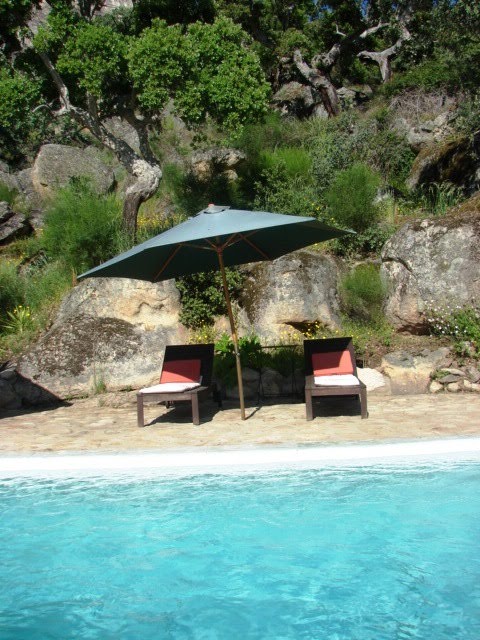
Here it is in all its glory in the barn meadow, first it was blasted by early June sun of up to 30c and now we have had 2 days of heavy rain which has just about finished it off, the camomile is just sweet smelling hay now. The rain is unexpected in June, I had just put up new shade sails at the cortijo, weather changes again tomorrow, back to blue skies and warm sun and my interrupted excercise programme in the pool. Here's my favourite corner of the pool area and I hope to be back there lying in the sun by tomorrow, in the meantime .....where's my umbrella?

Sunday, 2 May 2010
THE LITTLE VILLAGE OF IDANHA-A-VELHA WITH ITS MIGHTY PAST


The peaceful little village of Idanha-a-Velha in Portugal some 40KMS East of Alcantara on the Spanish border and 150kms from Finca al-manzil, has an illustrious past.
It was founded by the Romans and surrounded by an impressively solid stone defensive wall which still exists today. Then it was the Episcopal see under the Visigoths in the VI century before sinking back into obscurity following the Moorish invasion in the VIII century.
It is said to have been the birthplace of a Visigoth king with its own bishops at the cathedral which was restored at the beginning of the 16th century but thankfully still preserves inscribed and sculpted Roman stones. One of them dating from 16 B.C. links this Roman town of Igeditanos to Extremadura, it reads "Quintus Iallius, a citizen from Emerita Augusta (Mérida) has willingly given a sundial to Igeditanos"


In the Visigoth era, under the name of "Egitânea", the village witnessed a golden age, it became a diocese in 599 and was also gold coin mint. Nowadays all that is left are the ruins of the baptistry, the bishop's palace and the sé (cathedral).
It seems so odd, all that former Roman and Visigoth grandeur existing in this sleepy little village with maybe 20 inhabitants today. The ghostly aire is emphasized by a rambling dilapidated 20th century mansion owned by the Marrocos family, it looks as if it has been deserted for years and years, slowly decaying, chunks of stonework fallen and intricate woodwork rotting away. Apparently the family owned thousands of hectares of farmland in the area and evidently had to run away to Brazil at the time of the revolution in 1974 when the workers, in truth merely serfs, took over large estates all over Portugal. A little square in front of the eerie rural palace is dominated by a mulberry tree, obviously the local gossip place where we found out about the history of the mansion whilst indulging in a good old gossip. Aparently the mansion has been acquired by the local council and there are plans for renovation and conversion into a museum of local enthnology, I do hope this will happen.

From Largo de Amoreira (Mulberry tree square) a passage way leads to the Lagar de Vares, an ancient olive oil mill, an interesting part of the industrial archaeology of the area. This recently renovated space shows a first room with two great pressing bars and a boiler; in the next room you can see the olive oil storage tank and the milling place


We walk back through the Roman stones and a little way along the top of the massive 745 metre long Roman wall that surrounds the village, then down to the area outside the walls where a beautiful little chapel sits guarded by the dove of the holy spirit.

Subscribe to:
Posts (Atom)
LinkWithin
